Before it becomes embroidery, a motif exists as a drawing. A curve, a leaf, the outline of a fruit: a few lines are enough to suggest a composition. With thread, those lines take on a different presence.
Faïença was born from the meeting of my interest in embroidery and faience motifs. My sister Solenne illustrates the motifs from the Canary Islands. The figs project, drawn especially for embroidery, is a lovely opportunity to look at how an illustration can become a textile piece.
An inspiration that finds its place in thread
The story of Faïença includes an embroidery CAP project, then a piece of faience spotted during a trip to the Canary Islands. The repeating motifs, the curves and the colours echoed what I wanted to create.
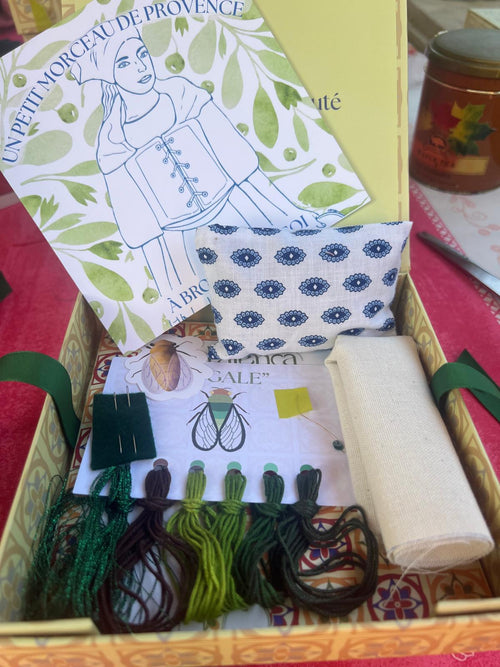
The Provence collection explores this world through subjects such as the cicada, the lemon, mimosa and lavender. Each can be read first as a drawing, then as a set of surfaces to embroider.
A lemon invites you to look at its shape and its skin. A bouquet raises the question of stems, leaves and flowers. Thread makes it possible to give a different answer to each element.
The fig drawing as a starting point
For this project, Solenne imagined a composition with whole fruits, a cut fig and large leaves. The motif therefore brings together several subjects in a fairly small space.
The whole fig has an easily recognisable silhouette. The cut fruit reveals the inside. The leaves bring direction and more jagged shapes.
This variety makes the drawing interesting to explore in embroidery: the idea is not to fill every area in the same way. You can think about what you want to highlight and how the elements will interact with one another.
A drawn line becomes a choice of stitch
If you study an illustration before embroidering it, start by distinguishing the outlines, the surfaces and the details. A line can become stem stitch or chain stitch; a surface can be worked with a filling of greater or lesser density.
These choices change how the drawing reads. A fine outline leaves a light shape. A bolder line emphasises its graphic character. Spaced-out stitches let the fabric remain visible.
For the figs featured in the journal, the tutorial gives the stitches and the order in which to work them. The leaves combine chain stitch and seed stitch, among others. The drawing thus acts as a guide, while the stitches bring their own texture.
Colour is not limited to the original drawing
Thread also introduces nuances that you discover as you stitch. In the figs tutorial, two purples are used on the whole fruit. The choice of one thread material or another also contributes to the result.
If you make your own version, you can start with the suggested colours, then imagine an adaptation. Keep a clear distinction between the fruits and the leaves, and try out your combinations on a small sample.
The illustration remains recognisable, but your palette and the way you place your stitches give the piece a presence all its own.
A motif that lives on once it is shared
When a drawing becomes an embroidery project, it passes into other hands. One person chooses a different colour, another leaves more fabric showing, a third works certain details more freely.
To take up a motif, first look at the practical information: its size, the elements to transfer and the stitches indicated. You can then decide where to follow the pattern and where to introduce your own choices.
The figs tutorial explains in particular how to adjust the drawing when printing and check its size. This preparation provides a common base, even if each piece will then take on its own character.
You can discover the figs pattern and its embroidery steps, or read the story of how Faïença was born to rediscover the inspirations behind the studio.