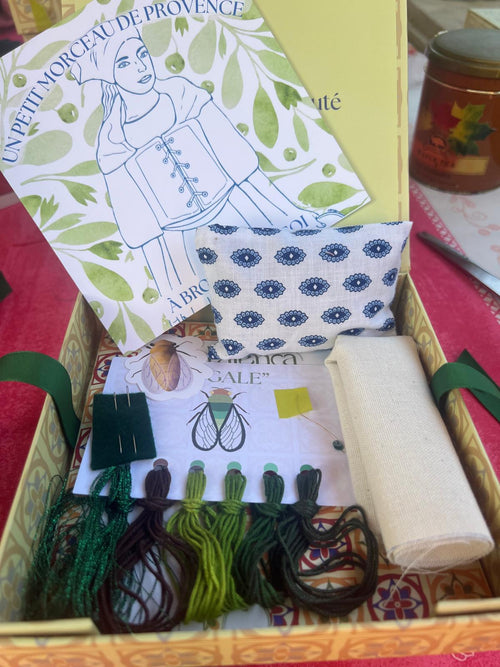
The cicada, a sun-drenched emblem of Provence, is embroidered in about 5 hours with a rich and varied palette of stitches. It's one of the most technical patterns in the Faïença collection, blending texture, relief and shine to capture all the liveliness of this summer insect.
The stitches used in this pattern
Long and short stitch
This is the main stitch for filling the cicada's body. It's worked in several passes: the first lays down stitches of varying length across the whole width of the area, and the following ones come back up in the middle of the stitches from the previous row to create a dense, even fill. The trick with long and short stitch is to vary the lengths in each row to avoid overly visible lines and get a natural gradient between the shades of green.
For the cicada's body, 4 shades of green are used, moving gradually from darkest to lightest, which gives that characteristic play of light.
Bullion knot
The cicada's antennae are embroidered in bullion knot, that little roll of thread wrapped around the needle which forms a raised, three-dimensional stitch. How to do it:
-
Bring the needle up where you want it.
-
Push the needle down at the end point without pulling the thread through, letting it come back up at the starting point.
-
Wrap the thread around the needle 6 to 12 times depending on the thickness you want.
-
Hold the wraps with your thumb and gently pull the needle all the way through, until you get a neat spiral of thread.
-
Push the needle down at the end point to secure the bullion knot.
Stem stitch
Stem stitch draws the cicada's legs. It's a line stitch that moves forward in half-steps: the needle comes back up halfway along the previous stitch, creating a continuous, slightly twisted line. It's worked in three lines.
Seed stitch
Seed stitch fills areas with an organised scatter of texture: small straight stitches pointing in every direction, placed next to one another without touching. Here it's used for the transition areas between colours, particularly on the cicada's head. It appears in two colours in this pattern (coffee and olive green) to create a lively texture.
Couched sequin stitch
The cicada's eyes are embroidered using couched sequin stitch, a technique that fixes a sequin onto the fabric with a single bead or a single stitch. Here, 4 mm iridescent emerald sequins on thread are used, for a bright, colourful eye effect.
How to do couched sequin stitch:
-
Bring the needle up at the edge of the chosen spot.
-
Place the sequin on the fabric and stitch down through its centre hole.
-
Bring the needle back up on the other side of the sequin, then stitch down again through the centre to secure it firmly.
-
Continue the same way for the other sequins if needed.
The iridescent emerald sequin catches the light and gives the cicada's eyes their characteristic sparkle. It's one of the small details that gives the pattern its magic.
Backstitch
Backstitch runs along the edges of the wings in green metallic thread, giving a precise, slightly shiny line. You move one stitch forward under the fabric, then come back to stitch into the end of the previous stitch. The resulting line is continuous with no gaps.
Chain stitch
Also worked in metallic thread, chain stitch forms a line of small loops linked to one another. Push the needle back down at exactly the point it came up, leaving a loop, come back up 3 to 4 mm further along, passing inside the loop, and pull gently to form the next loop. It traces the veins or the most delicate outlines.
Zigzag whipped running stitch
Zigzag whipped running stitch creates an elegant wavy line. First work a line of straight stitches about 4 mm long, then turn the needle eye-first and weave it through the stitches, alternating above and below, to form a regular wave. Worked in green metallic thread, it adds a subtle touch of relief and shine to the pattern.
Embroidery order
To embroider the cicada in the right order: start with the antennae (bullion knot), then the legs and head (stem stitch and seed stitch), the eyes (couched sequin stitch with emerald sequins), the body (long and short stitch, colour by colour from darkest to lightest), and finish with the wings in metallic thread (backstitch, chain stitch, zigzag).
This pattern is a lovely way to discover the richness of embroidery stitches: relief with the bullion knot, texture with seed stitch, shine with the metallic thread. Five hours of embroidery that fly by, like a beautiful Provençal afternoon.