For this new embroidery, I wanted to step outside my usual habits and, above all, try new things. New threads, new stitches, and an approach a little more inspired by crewelwork, that embroidery technique traditionally worked in wool.
The starting point was a fairly simple wish: to embroider figs.
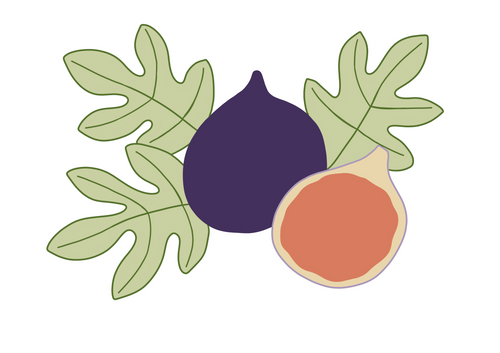
A pattern drawn specially for the embroidery
The pattern was drawn by my sister, the illustrator behind Sober Studio.
She'd already created a whole collection of fruit illustrations, but figs weren't part of it yet. So she drew them specially for this embroidery project.
I loved the composition, with the whole fruits, the fig cut in half, and the large leaves. Above all, it let me work several different textures and so test several stitches without it feeling like I was cramming them in everywhere just to experiment.
Testing Saint-Pierre wool
For the first version, I wanted to test Saint-Pierre wool threads, offered by J. Toulemonde.
I regularly work with silk threads or Appleton wool, but much less with French wool. So I was curious to discover how Saint-Pierre wool would look and how it would behave when embroidered, particularly in terms of texture, volume and ease of working.
Since I also wanted to dig deeper into crewelwork, it was the perfect opportunity.
To choose the stitches, I mainly drew inspiration from the Royal School of Needlework's book, RSN Book of Embroidery: All Techniques, and especially the section devoted to crewelwork.
The goal wasn't necessarily to use a huge number of different stitches, but rather to find the one that would work best for each part of the design.
The leaves: many attempts before finding the right combination
The leaves are probably the part I hesitated over the most.
At first, I simply planned to fill them with satin stitch. It seemed a fairly logical solution for creating a large, solid area while following the direction of the leaves.
I tried it.
Then I started over a second time.
And in the end, I still didn't really like the result.
It looked too uniform compared to what I'd imagined, and I felt the leaves were losing some of their character.
So I changed my approach completely.
I started by embroidering the leaf outlines and their veins in chain stitch. This let me clearly define their structure while adding a bit of relief.
But once that part was done, the inside felt too empty.
So I decided to fill the spaces with seed stitch.
I liked the result much better. The chain stitch clearly outlines the leaves, while the scattered little stitches add a light texture without weighing down the whole thing.
I still wanted to try one last option on another leaf, using feather stitch.
On paper, I liked the idea a lot. In practice, the result wasn't convincing enough.
So I went back to the combination that worked best: chain stitch and seed stitch.
The whole figs: discovering Burden stitch
For the fruits that aren't cut open, I had mainly two ideas.
The first was to use Burden stitch, a stitch I'd wanted to try for a while.
The second was to work a fill in trellis stitch.
I started with Burden stitch and, this time, I didn't need to make multiple attempts.
The result matched exactly what I was looking for.
This stitch creates a very graphic fill with a slightly structured texture, particularly interesting when worked in wool. It also lets you play with several colours and add more depth to the fruit.
So I decided to keep this stitch for the whole figs.
I still think trellis stitch could have been a very good alternative. Maybe for a future version.
The cut fig: playing with lines and small stitches
For the fig cut in half, I wanted to avoid using chain stitch yet again.
So I used stem stitch to draw the outer part of the fruit.
I worked three lines side by side: a purple line flanked by two cream lines.
This creates a fairly defined border while echoing the different shades visible in a fig's skin.
To depict the inside of the fruit, I wanted a much more irregular, organic texture.
So I used French knots.
They make it easy to create that small grainy effect reminiscent of the many seeds found in a fig's flesh.
It's a fairly simple part technically, but one that brings a lot of texture to the pattern.
Starting over entirely with Appleton wool
Once all the stitches were settled, I could easily have stopped there.
But since this project was also a chance to test wool threads, I decided to start the whole pattern over again using Appleton wool.
This second version let me compare the two threads fairly directly, using exactly the same stitches.
Appleton wool is thicker than Saint-Pierre wool.
That has an obvious advantage: areas fill in much faster.
On the other hand, I found it harder to work with.
I ran into more knots while embroidering, and above all far more problems with the wool fraying or felting from repeated passes through the fabric.
On certain stitches or heavily worked areas, this genuinely made things harder.
Saint-Pierre wool felt nicer and more consistent to handle, while Appleton gives a thicker result and lets you fill areas more quickly.
So, two fairly different threads, even though both are perfectly suited to this type of embroidery.
The final result
After all these attempts, the final pattern actually combines quite few stitches:
-
chain stitch for the leaf outlines and veins
-
seed stitch to fill them
-
Burden stitch for the whole figs
-
stem stitch for the border of the cut fig
-
French knots to depict its flesh
This project mostly reminded me of something I love about embroidery: the first choice isn't always the right one.
A stitch can look perfect on paper and end up not working at all once embroidered. Conversely, a combination worked out after several attempts can become the one that gives the pattern all its personality.
And sometimes, you just have to accept that you'll unpick, start over, and try something else.

I don't think this will be my last crewelwork project. There are still so many stitches and combinations I want to experiment with, and wool really does give a particular texture to botanical and fruit patterns.