To start hand embroidery, you need very little: a 15 cm embroidery hoop, cotton fabric, cotton embroidery floss, an embroidery needle, and a pattern transferred onto the fabric. You first learn four basic stitches (stem stitch, French knot, satin stitch, chain stitch), then dive into a first pattern with simple shapes. No expensive materials, no prior experience.
Traditional embroidery is made for you. Everything you need to know before picking up a needle for the first time.
In this guide:
- What is traditional embroidery?
- Why start
- What do you really need?
- How do you learn the stitches?
- Which pattern should you choose first?
To go further, each step has its own detailed guide: embroidery stitches, transferring a pattern onto fabric, finishing and framing your hoop, choosing between a kit and loose materials, and 5 tips to improve your embroidery.
What is traditional embroidery?
I hear it often: embroidery brings to mind grandmothers, endless patience, hours spent counting threads. It sounds a little intimidating, or old-fashioned.
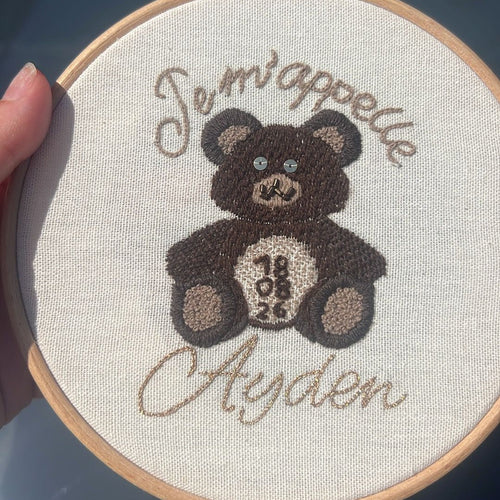
And yet, I promise you, if you can hold a pencil, you can embroider. Traditional needle embroidery is exactly that: drawing lines, filling shapes, creating texture with thread and fabric. It's within everyone's reach, at any age, with no experience needed.
Traditional needle embroidery is one of the oldest textile art forms in the world. In every culture, on every continent, women (and men!) have embroidered to decorate, to tell stories, to pass things on.
Unlike cross-stitch, which follows a strict grid square by square, traditional embroidery is freer, more expressive. You draw with the thread. You follow the outline of a pattern, fill in shapes, create relief and texture.
✦ In short: cross-stitch is colouring inside squares. Traditional embroidery is drawing with thread. Both are beautiful, but traditional embroidery offers far more creative freedom.
The basic stitches you'll use are few and quick to learn:
- Stem stitch, for outlines, stems, curved lines
- French knot, for small raised dots, flower centres, texture
- Satin stitch or fishbone stitch, for large coloured areas
- Chain stitch, for decorative details
That's it. With these four stitches, you can embroider the entire Provence collection. Each one is detailed, step by step, in the embroidery stitch guide.
What embroidery does for your hands, and your head
Slow living is a big topic right now, and embroidery is the perfect embodiment of it. In a fast-moving world, holding a hoop and placing stitches one by one is a quiet act of resistance.
Many tell me embroidery has become their daily moment of decompression. You don't need absolute silence or a dedicated space — you can embroider while listening to a podcast, watching a show, or enjoying the sun on a balcony.
It's an activity that doesn't demand your full attention, just enough to anchor your hands and calm your mind.
And then there's the pride of making something with your own hands. Hanging an embroidery you made yourself is different from a bought poster. It's a presence, a story, an object full of meaning.
What do you really need to get started?
The good news: not much. Embroidery is one of the least expensive creative hobbies there is. Here's the strict minimum:
- An embroidery hoop, 15 cm is the ideal size to start
- Cotton fabric, plain or lightly textured, not too thin
- Embroidery thread, stranded cotton, the most common, affordable, and easiest to find
- An embroidery needle, round-tipped, with a large eye
- A pattern to follow, printed directly on the fabric or traced with pencil
- Embroidery scissors, small and precise
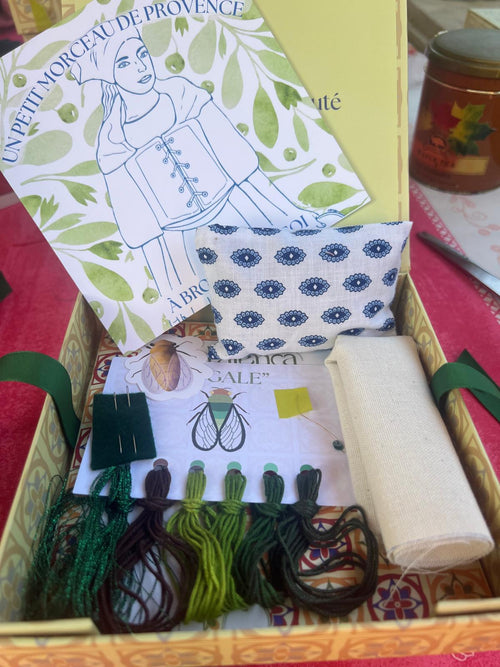
If you choose a kit from the Provence collection, all of this is already included in the magnetic box: cotton fabric with the printed pattern, threads, the 15 cm hoop, and the stitch booklet with all the instructions. All you're missing is the scissors.
The biggest myth about embroidery: that you need expensive or hard-to-find materials. In reality, everything can be bought at a haberdashery or online for under 20 euros. And with a kit, it's even simpler: everything is designed together, the colours are matched, the fabric is ready. To weigh the pros and cons, see embroidery kit or loose materials: what to choose as a beginner.
If you buy your fabric separately, you'll then need to transfer the pattern onto it: four methods are possible depending on the fabric and the pattern.
How do you learn the stitches?
There are several ways to learn the basic stitches. By far the best is to see them in motion. A text can describe a stem stitch in ten lines, but a thirty-second video makes it instantly clear.
That's why I regularly share video tutorials: the precise movements, the right angle, the right thread tension. You can watch, pause, replicate, start again. At your own pace, as many times as you need.
The embroidery stitch guide brings these tutorials together, with, for each stitch, the step-by-step technique, the threads to use, and examples of patterns to use it on. You'll also find tutorials on Instagram: @faienca_broderie.
For the Provence collection, each kit comes with a full stitch booklet: illustrations of every stitch, colour guidance, and finishing tips. Everything is designed so a complete beginner can succeed, and enjoy it.
Once you've got your first stitches under your belt, 5 tips to improve your embroidery will help you gain consistency.
Which pattern should you choose first?
If you're a beginner, I recommend starting with the Cigale pattern, available as a kit. If you have more patience, you could try the Citron pattern. Both patterns were designed with clear shapes, easy-to-define areas, and a harmonious thread palette that makes every step enjoyable.
To see which stitches each pattern requires before you dive in: Cigale pattern stitches and Citron pattern stitches.
The Lavande and Mimosa patterns are available as PDFs, perfect if you already have your own materials and want to dive straight in with your own fabric: Lavande pattern stitches, Mimosa pattern stitches.
And if you have no desire to embroider yourself but like the idea of having a piece of Provence embroidery at home, the finished pieces are available, hand-made, ready to hang.
Embroidery is waiting for you. There's no right time to start, just the moment you pick up the needle.