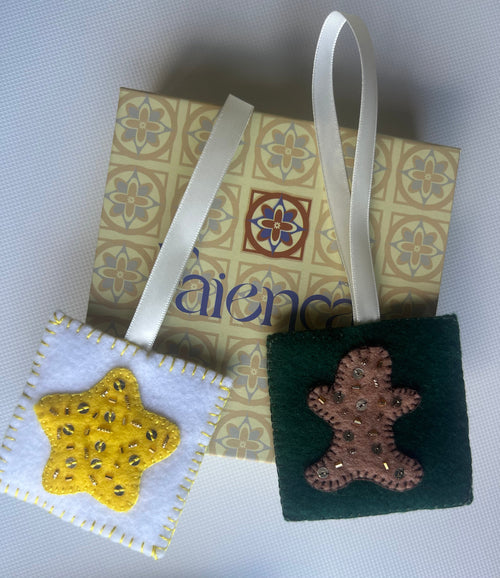
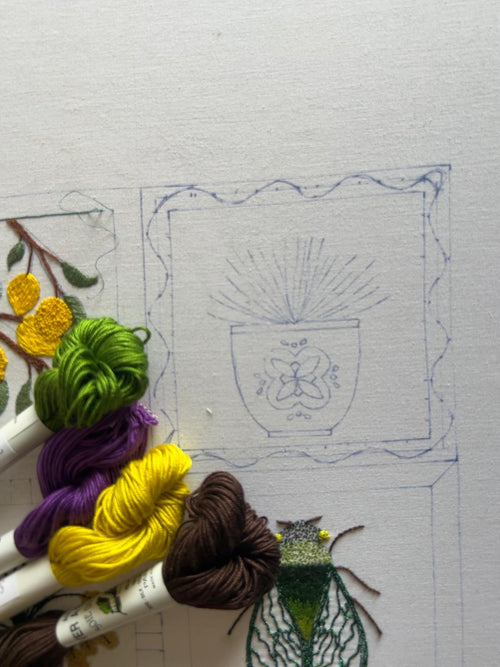
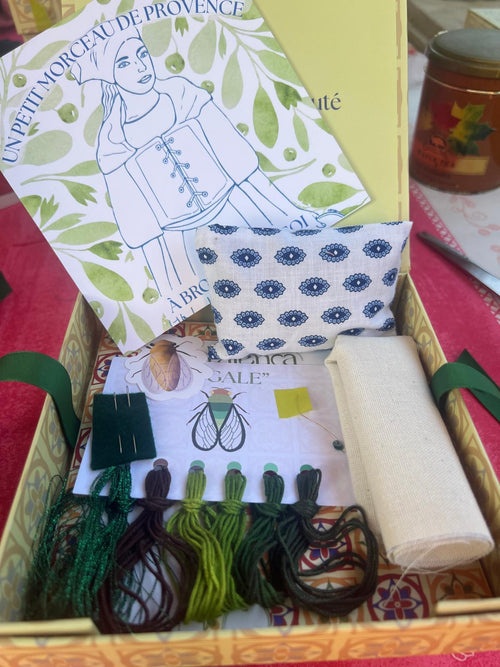
People often imagine that embroidery follows a straight line: a drawing, a few threads, and the design appears stitch by stitch. In my studio, it is rarely that simple. A design goes through doubts, breaks and sometimes several versions before it becomes a pattern I can offer you.
Here is how I work, from the very first idea to the final touches.
It all starts with an idea
To begin a new design, I start from an idea, a motif I feel like embroidering. It might be a shape I spotted while travelling, a detail on a piece of faience, a fruit, a sea creature.
At this stage, nothing is set yet. I simply hold on to the urge, and to a more or less clear picture of what I would like to create.
The sketch: imagining the embroidered result
Then I pick up a pencil and draw. I am not just looking for a pretty drawing: I try to imagine how it will look once embroidered. Will this line become a fine outline or a filled area? Will this curve be pleasant to follow with the thread?
I write my ideas for stitches and materials straight onto the sketch: a chain stitch here, a line of beads there, a circle of sequins in the middle. I already place a few materials on the page to see if everything works together.

Choosing the materials, the step where I get most lost
Next comes choosing the materials. This is where I spend the most time.
In front of my threads, beads and sequins, I imagine everything else I could make with what I have. I wonder why I don't have the perfect material, the one I have in mind. I almost go as far as benchmarking which materials go with what: this texture with that colour, this thread on that fabric.
This step can seem long, but it feeds everything that follows. It is often here that the combinations giving the design its character are born.

Setting up the frame and getting started
Once the materials are chosen, I transfer the design, set up the embroidery frame and get started.
The first stitches are always a special moment: the drawing leaves the paper and starts to exist in thread and fabric. I discover how the threads behave, how the light plays on the beads, whether the colours really go together once embroidered.

Halfway through, I stop
And then, often, right in the middle of the piece, I stop. I feel that something is off, without always knowing what.

So I step back. I go for a walk, I take a shower, I sleep on it. It reminds me of the good old days, before AI existed, when a baffling bug popped up in my web app: however hard you stared at the screen, the solution rarely came while sitting at the keyboard.
Embroidery is the same. My brain eventually understands what is wrong and finds a new, more beautiful way of doing it. Not always, but often.
A pattern that keeps evolving
Even when a piece of embroidery is finished, the story is not necessarily over. Several months later, new ideas still come up and I update the pattern.
I often have to change it several times before getting the wow effect. One stitch swapped for another, a colour adjusted, the stitching order rethought so the work feels more pleasant: these small touches are what make the difference in the final result.
The Provence collection is a good example. In this photo, the first and final versions of the cicada, the lavender and the mimosa are side by side: the designs are the same, but the frames, the materials and the finishes have changed.

And you, how do you work?
If you embroider, you may recognise some of these steps: the time spent in front of your threads, the doubt halfway through, the idea that arrives when you least expect it. Letting a piece rest is also part of the work.
You can find the result of this process in the Faïença embroidery kits and the PDF patterns, or read how a Faïença design is born, from illustration to embroidery.

Embroidery kit
Boîte mystère de Noël - Ornement à broder
€20,00