Hand embroidery stitches fall into four main families: line stitches (stem stitch, backstitch, split stitch), filling stitches (satin stitch, long and short stitch, Burden stitch, seed stitch), knot and raised stitches (French knot, bullion knot, spider web stitch) and decorative stitches (chain, blanket, feather, couching). Most patterns are embroidered with just four to six stitches.
Hand embroidery offers a wide variety of stitches for drawing lines, filling surfaces, adding volume, or bringing small textures to a pattern.
Some stitches, like stem stitch or satin stitch, are among the essential techniques to know when starting out. Others, like trellis stitch or certain couching techniques, let you explore more traditional and more complex embroidery.
In this guide, we've brought together the main embroidery stitches used at Faïença. Each technique will progressively get its own tutorial, so you can learn at your own pace.
Embroidery stitches at a glance
| Stitch | Family | Level | Ideal for |
|---|---|---|---|
| Stem stitch | Line | Beginner | Outlines, stems, curves |
| Backstitch | Line | Beginner | Fine outlines, lettering |
| Split stitch | Line | Beginner | Outlines, preparing satin stitch |
| Chain stitch | Line / filling | Beginner | Lines, outlines, decorative fills |
| French knot | Raised | Intermediate | Flower centres, seeds, textures |
| Satin stitch | Filling | Beginner | Small areas, petals, leaves |
| Long and short stitch | Filling | Intermediate | Gradients, large areas, needle painting |
| Seed stitch | Light filling | Beginner | Textures, backgrounds, irregular fills |
| Burden stitch | Filling | Intermediate | Large areas, crewelwork, woven effect |
| Fishbone stitch | Botanical | Beginner | Leaves, branches |
| Bullion loop / lazy daisy stitch | Botanical | Beginner | Petals, leaves, small flowers |
| Spider web stitch | Raised | Intermediate | Roses, circular elements |
| Bullion knot | Raised | Intermediate | Petals, buds, raised details |
| Blanket stitch | Decorative | Beginner | Edges, outlines |
| Feather stitch | Decorative | Beginner | Foliage, branches |
| Couching | Decorative | Intermediate | Thick threads, metallic threads, goldwork |
Essential stitches for beginners
Stem stitch
Stem stitch is a line stitch especially used for embroidering outlines, flower stems or curves. The stitches overlap slightly and form a continuous line reminiscent of a small twisted cord. It's a very versatile stitch found in both traditional and contemporary embroidery.
Ideal for: outlines, stems, curves and decorative lines.
Backstitch
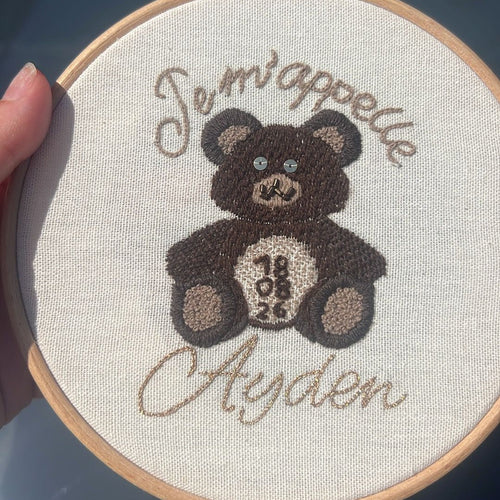
Backstitch is one of the simplest hand embroidery stitches. It creates a regular line by working each new stitch back into the end of the previous one. It's especially used for fine outlines, lettering, or small details.
Ideal for: outlines, lettering and precise details.
Split stitch
Split stitch is worked by bringing the needle up directly through the middle of the previous stitch. This creates a slightly textured but very regular line. At Faïença, we use it in particular to prepare certain outlines before working satin stitch. This edge gives a cleaner, slightly more raised finish.
Ideal for: outlines, lines and preparing satin stitch.
Chain stitch
Chain stitch forms a series of small loops resembling the links of a chain. It can be used to draw a line, fill a surface, or create a decorative texture. It's also a very old stitch found in many embroidery traditions around the world.
Ideal for: lines, outlines and decorative fills.
French knot
The French knot creates small raised dots on the surface of the fabric. The thread is wrapped around the needle before it's pushed back through the fabric, forming a small knot. Used alone or in clusters, it's perfect for depicting the centre of a flower, small seeds, or creating heavily textured surfaces.
Ideal for: flowers, pistils, seeds and textures.
Filling stitches
Satin stitch
Satin stitch is a filling technique made up of parallel stitches placed side by side. The thread fully covers the surface of the fabric to give a smooth, even result. Regularity, stitch direction, and thread tension all play an important role in the final result.
Ideal for: small areas, petals, leaves and graphic shapes.
Long and short stitch
Long and short stitch is a filling technique that lets you work larger areas and create gradients. Unlike classic satin stitch, the stitches are worked in different lengths so that successive rows interlock with one another. This technique is especially used in needle painting to create colour transitions and more natural volumes.
Ideal for: gradients, petals, animals and needle painting.
Seed stitch
Seed stitch consists of scattering many small stitches over a surface. They can be even or deliberately irregular, depending on the effect you want. This stitch is particularly good for adding texture without fully covering the fabric.
Ideal for: light textures, backgrounds and irregular fills.
Burden stitch
Burden stitch is a traditional filling stitch especially associated with crewel embroidery. Horizontal threads are laid over the fabric, then held down with small offset vertical stitches. This structure creates a rhythmic, geometric fill that's very effective for large areas.
Read the full guide to Burden stitch
Ideal for: decorative fills, crewelwork and Jacobean embroidery.
Stitches for embroidering flowers and plants
Fishbone stitch
Fishbone stitch is made up of a series of diagonal stitches crossing over a central axis. Its shape naturally resembles the structure of a leaf or a branch. The length and angle of the stitches can easily be adapted to fit the shape of the pattern.
Ideal for: leaves, branches and plant motifs.
Bullion loop stitch (lazy daisy)
Bullion loop stitch, also called detached chain stitch, creates a small independent loop. Several loops gathered around the same centre can quickly form a flower. It's a simple but very versatile stitch, particularly well suited to floral patterns.
Ideal for: petals, leaves and small flowers.
Spider web stitch
Spider web stitch creates raised circular shapes. A small structure of straight stitches is first embroidered onto the fabric. Thread is then woven around these spokes to gradually build up a round, textured shape. It's particularly popular for working roses.
Ideal for: roses, flowers and raised circular elements.
Bullion knot
The bullion knot is a raised stitch made by wrapping the thread several times around the needle. Once the thread is pulled through the wraps, you get a small, elongated, slightly cylindrical element. It can be used alone or combined with several other stitches to create flowers and heavily textured patterns.
Ideal for: petals, flowers, buds and raised details.
Decorative and textured stitches
Blanket stitch
Blanket stitch creates a series of stitches held by a small loop. It's traditionally used to finish the edges of fabric, but it can also become a genuine decorative stitch. By varying the length and spacing of the stitches, you can achieve many different effects.
Ideal for: edges, outlines and decorative patterns.
Feather stitch
Feather stitch forms a supple line made up of small alternating branches. It can be worked very regularly, or adapted freely to follow the shape of a plant. It's particularly good for creating light foliage or decorative lines.
Ideal for: foliage, branches and edging.
Couching
Couching involves laying a thread on the surface of the fabric without passing it fully through. A second thread then holds the first in place at regular intervals with small stitches. This technique is particularly useful for working with thick, fragile, metallic threads, or threads that are difficult to pull through fabric.
Ideal for: thick threads, metallic threads, outlines and goldwork.
Which embroidery stitch should you choose?
Choosing a stitch mainly depends on the effect you want to achieve.
To embroider an outline, you can use stem stitch, backstitch or split stitch.
To fill a small area, satin stitch is particularly well suited.
To create a gradient or a more natural fill, long and short stitch allows for more variation.
To embroider flowers, bullion loop stitch, French knots, spider web stitch, or bullion knots offer many possibilities.
Finally, to add texture, you can experiment with seed stitch, Burden stitch, or various couching techniques.
That said, there isn't necessarily just one “right” stitch for a given shape. A leaf, for example, can be embroidered in satin stitch, fishbone stitch, feather stitch, or using a needle painting technique. The choice of stitch directly shapes the style of the embroidery.
See these stitches applied to a pattern
Each pattern in the Provence collection combines several of these stitches. To see how they come together in a complete embroidery:
- The stitches of the Lavande pattern: couched trellis, split stitch, stem stitch and bullion loop.
- The stitches of the Mimosa pattern: chain stitch, stem stitch, feather stitch and French knot.
- The stitches of the Cigale pattern: long and short stitch, bullion knot, seed stitch and sequins.
- The stitches of the Citron pattern: the three variations of satin stitch, split stitch and French knot.
Frequently asked questions
Which embroidery stitch should you learn first?
Stem stitch and satin stitch. The first covers almost every outlining need, the second lets you fill a shape. With these two stitches alone, you can already embroider a simple pattern from start to finish.
How many stitches do you need to know to embroider a pattern?
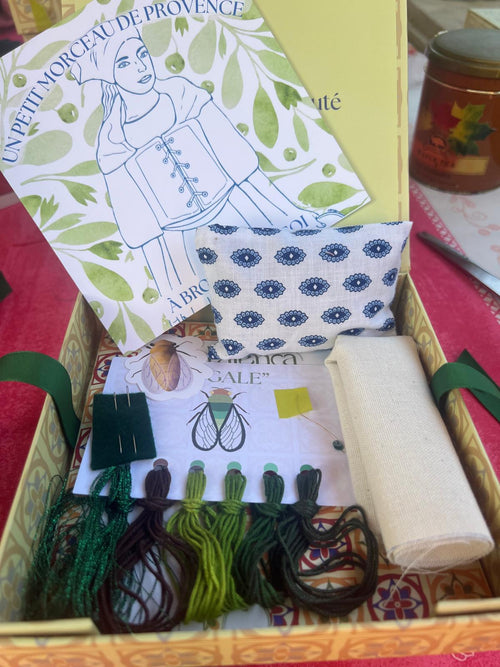
Four to six is enough for most patterns. Faïença's Provence collection kits are embroidered with four basic stitches for the more accessible patterns, and a few more for advanced ones like the Cigale or the Citron.
What's the difference between traditional embroidery and cross-stitch?
Cross-stitch follows a grid and is worked square by square. Traditional needle embroidery is free-form: you follow the outlines of a design, fill in shapes, and create textures using different stitches.
Which stitch should you use to embroider a leaf?
It depends on the look you want. Satin stitch gives a smooth, solid leaf, fishbone stitch gives a veined leaf, feather stitch gives lighter, airier foliage.
Learning embroidery stitches with Faïença
At Faïença, we explore hand embroidery through both traditional and contemporary techniques. Our patterns and tutorials are especially inspired by Provence, the Mediterranean, and the plant world. We also love experimenting with different materials and techniques drawn from fine embroidery and crewelwork.
This page will grow over time with new stitches, tutorials and project examples. You can browse each guide to discover the step-by-step technique, the threads to use, common mistakes, and examples of embroideries where it's used.